
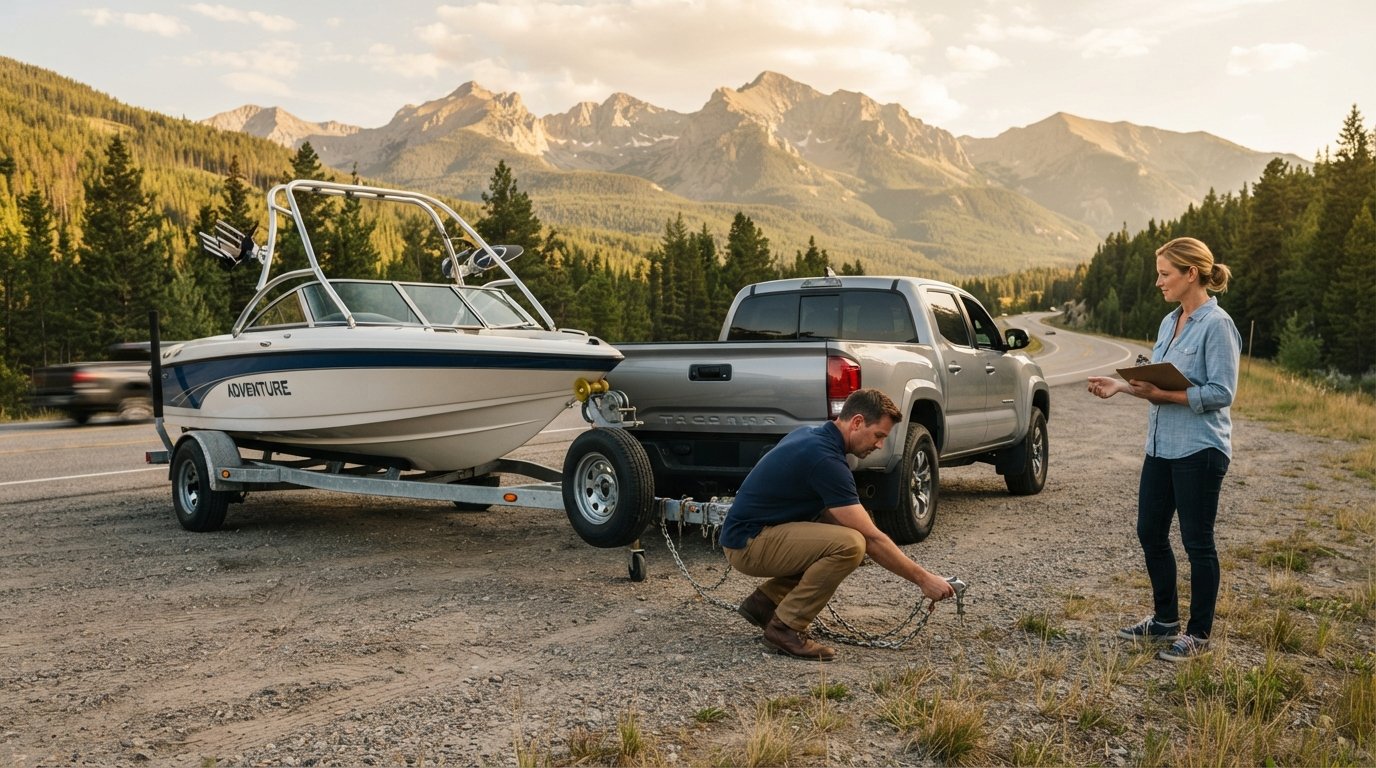
Car Insurance for Drivers Who Tow Trailers or Boats
Car insurance for drivers who tow trailers or boats hinges on liability limits and separate trailer coverage. Call (833)-275-7533 to compare quotes.

By Celeste Rowan
You hook up the boat for a weekend at the lake, or load the utility trailer for a move, and a quiet question creeps in: if something goes wrong on the highway, does my auto policy actually cover this? The answer is more nuanced than most drivers expect, and the gap between what you assume and what your policy states can cost thousands. Car insurance for drivers who tow trailers or boats is not a single product you buy off a shelf; it is a set of coverage decisions that determine who pays when the trailer, the boat, the cargo, or another driver is damaged. Getting those decisions right before you pull out of the driveway is far cheaper than sorting them out after a claim.
How Liability Follows the Tow Vehicle, Not the Trailer
The foundation of almost every towing claim is this principle: liability coverage follows the tow vehicle. When your truck or SUV is pulling a trailer, the liability portion of your auto policy typically responds to injuries or property damage you cause to others. The trailer itself is generally treated as part of the towing combination, not as a separate vehicle requiring its own liability policy. This is why a driver with a well-funded liability limit on the tow vehicle usually has a reasonable starting point for towing risk.
That principle has limits. If the trailer becomes detached and rolls into another car, or if the load shifts and strikes a pedestrian, the claim still generally routes back to the towing vehicle's policy. But the amount available is capped by the limits you chose, and those limits were probably selected with everyday driving in mind, not with a 6,000-pound boat and trailer behind you. Increasing bodily injury and property damage liability limits is one of the most direct ways to close that gap. A driver carrying state minimums while towing a boat is taking on personal financial exposure that a modest limit increase would largely resolve.
There is also the question of which policy responds when multiple vehicles are involved. If you tow with a vehicle owned by someone else, or tow a trailer owned by a friend, the policies can interact in ways that surprise people. The safest approach is to confirm in writing which policy is primary before you borrow a truck or a trailer. A quick call to your agent, documented in an email, removes the ambiguity that otherwise surfaces at the worst possible moment.
When You Need Separate Trailer or Boat Coverage
Here is where assumptions break down. Your auto policy's liability coverage may protect others, but it typically does not pay to repair or replace the trailer itself. Physical damage to a trailer is usually excluded unless you add specific coverage. For a small utility trailer, that exclusion may be an acceptable risk. For an enclosed cargo trailer, a boat trailer, or a camper, the replacement cost can run into five figures, and the exclusion becomes a real problem.
Boats add another layer entirely. A boat is generally not covered by an auto policy at all, even while it is being towed. The auto policy may respond to liability arising from the towing operation, but the boat's hull, motor, and equipment need a separate watercraft policy. Many homeowners policies offer limited boat coverage, often capped at a low horsepower threshold and a modest dollar amount, which is rarely enough for a serious loss. Drivers who assume their boat is covered because it is attached to a covered truck are among the most common victims of claim denials in this category.
Use this checklist to decide whether you need standalone coverage:
- Trailer value: If replacing the trailer would sting, add trailer physical damage coverage or a standalone trailer policy.
- Boat ownership: Any boat with meaningful value, especially one with a motor, generally needs a dedicated watercraft policy.
- Loan or lien: If a lender holds a lien on the trailer or boat, the lender will almost certainly require physical damage coverage.
- Business use: Towing for hire, hauling equipment for a company, or using the trailer in a business usually requires a commercial policy.
Notice that the decision is driven by value and use, not by the size of the trailer alone. A cheap utility trailer used twice a year for household projects is a different risk than a $40,000 boat that goes to the lake every summer weekend. Matching coverage to the actual exposure, rather than to a vague sense of what feels safe, is the core discipline of insuring towed property.
Cargo, Equipment, and the Gaps That Catch Drivers
Even drivers who insure the trailer often forget what is inside it. Cargo carried on or in a trailer is typically excluded under auto policies, and homeowners policies impose special sublimits for property in or on a vehicle. That means the generator, the tools, the fishing gear, or the personal watercraft accessories riding in the trailer may have little or no coverage after a theft or accident. For occasional household hauling, the exposure may be tolerable. For anyone regularly transporting valuable equipment, a scheduled personal property endorsement or a dedicated inland marine policy is the cleaner solution.
Equipment attached to the boat deserves the same scrutiny. Electronics, trolling motors, anchors, and safety gear may be covered under a watercraft policy, but only if the policy's equipment provisions are adequate. Reviewing the declarations page line by line is tedious, but it is the only reliable way to know what is protected. Drivers who discover a gap after a loss often find that the missing coverage would have cost less than a tank of fuel per year.
Towing also changes how insurers view your driving risk. A driver who tows regularly may be classified differently than one who does not, and some carriers ask specifically about towing at the time of application. Disclosing towing when you request quotes is essential, because a claim arising from an undisclosed towing use can create friction. When you compare rates, mention the trailer, the boat, and how often you tow. The quotes you receive will be more accurate, and the policy you buy will be less likely to surprise you. Drivers with complicated histories should also review guidance on auto insurance for drivers with multiple traffic violations, since towing combined with a spotty record can sharply limit carrier options.
Accident Scenarios: Who Pays for What
Abstract coverage rules become concrete only when you walk through real scenarios. Consider four common situations and how the money typically flows.
- You rear-end another car while towing a boat. The tow vehicle's liability coverage responds to the other driver's injuries and property damage. Your boat and trailer are generally not covered for damage under the auto policy unless you added physical damage coverage.
- The trailer separates and strikes a parked car. Liability again routes to the tow vehicle's policy, subject to your limits. The trailer's own damage is excluded absent specific coverage.
- Someone steals equipment from your trailer. Auto policies typically exclude cargo, and homeowners coverage may apply only up to a sublimit. Scheduled property coverage is the reliable answer.
- A storm damages your boat while it sits on the trailer in storage. The auto policy does not respond. A watercraft policy handles storm damage to the boat, and trailer coverage handles the trailer if purchased.
These scenarios share a theme: the auto policy is built to protect others from your driving, not to protect your toys. Once that distinction is clear, the coverage decisions become much easier to make. The goal is not to buy every endorsement available; it is to identify which losses you could absorb yourself and which ones would genuinely damage your finances. Most drivers find that trailer and boat coverage is inexpensive relative to the value it protects, which makes the decision straightforward once the exposure is visible.
Cost is also influenced by factors outside the towing itself. Credit history, driving record, location, and the vehicles on the policy all shape the premium. Drivers who are also managing a car payment should look at car loan refinancing options to free up monthly cash, since lowering a loan payment can make room for the trailer and watercraft coverage that actually protects the assets. Insurance and lending decisions reinforce each other, and treating them together often produces a better overall financial result.
How to Request Quotes With Towing Disclosed
The quality of your quotes depends on the quality of the information you provide. Drivers who request quotes without mentioning the trailer or boat often receive prices that do not reflect their real risk, and the resulting policy may exclude the very activity they care about. A structured approach avoids that outcome. Start by gathering the details insurers will ask about, then present them clearly when you request quotes.
- Tow vehicle year, make, model, and current coverage limits.
- Trailer type, length, value, and whether it has brakes or a lien.
- Boat year, length, motor horsepower, and storage location.
- How often you tow, and whether any towing is for business.
- Any accidents, tickets, or claims in the past three to five years.
With that information in hand, request quotes from multiple carriers and ask each one two direct questions: does this policy cover the trailer for physical damage, and does it respond to liability while towing the boat? Written answers to those questions are worth more than any verbal assurance. Comparing several quotes side by side also reveals how differently carriers treat towing risk, which is why a comparison platform that presents multiple offers is more useful than a single carrier's website.
Finally, revisit the coverage annually. Trailers get upgraded, boats get replaced, and towing habits change. A policy that fit a small utility trailer may be inadequate two years later when a larger boat enters the driveway. An annual review, timed with your renewal, keeps the coverage aligned with reality and often uncovers discounts along the way. Towing drivers who take these steps generally find that car insurance for drivers who tow trailers or boats is manageable, predictable, and far less expensive than the losses it prevents.