
How Your Zip Code Determines Auto Insurance Costs
Your zip code shapes territory ratings, theft risk, and claim costs. Compare quotes after any move and call (833)-275-7533 to confirm potential savings.

By Holden Pierce
Two drivers with identical cars, clean records, and the same coverage limits can pay wildly different premiums simply because they live on opposite sides of a city. The reason sits in a five-digit number you probably never think about: your zip code. Insurers treat location as one of the strongest predictors of risk, and understanding how your zip code determines auto insurance costs can put real money back in your pocket, whether you are shopping for a new policy or planning a move across town.
Location-based pricing is not a gimmick or a hidden fee. It reflects years of claims data showing that certain areas produce more accidents, more thefts, and more expensive repairs. In dense urban cores, traffic volume and parking density raise the odds of a fender bender. In rural counties, long commutes and wildlife collisions play a bigger role. Insurers distill all of this into territory ratings, then apply them to your premium. The result is that your address can influence your rate as much as your driving record does.
The good news is that this factor is not entirely out of your control. By understanding how territory ratings work, verifying your garaging address, and comparing quotes after any move, you can confirm whether you are overpaying and act accordingly.
What Territory Ratings Are and Why Insurers Rely on Them
A territory rating is an insurer's statistical shorthand for the risk profile of a geographic area. Insurance companies group zip codes, census tracts, or counties into territories and assign each one a rating factor. That factor is multiplied against your base rate along with other variables like age, vehicle type, and driving history. A territory with a high rating factor pushes your premium up; a low rating factor pulls it down.
Insurers build these ratings from historical claims data. They examine how often drivers in a given area file claims, how severe those claims tend to be, and what types of losses dominate. A zip code with frequent multi-vehicle accidents might see higher bodily injury costs, while a zip code with rampant vehicle theft might see higher comprehensive claims. Both patterns raise rates, but for different reasons.
Territory ratings are regulated at the state level, which means insurers cannot simply invent numbers. They must file their rating territories and factors with state insurance departments, and those filings are often public. If you are curious about how your area is classified, you can sometimes review filed territory maps through your state regulator. This transparency exists because location is such a powerful pricing lever that regulators want to ensure it is applied fairly and without discriminatory intent.
It helps to think of your zip code as a risk fingerprint. It captures the environment your car operates in every day: the roads it travels, the parking spots it occupies overnight, and the traffic patterns it encounters. Insurers are not judging your neighborhood; they are pricing the statistical likelihood that a vehicle stored and driven there will generate a claim.
The Three Location Factors That Move Your Premium
While insurers use many data points, three location-driven factors do most of the heavy lifting when your zip code determines auto insurance costs. Understanding each one helps you see why two nearby addresses can produce very different quotes.
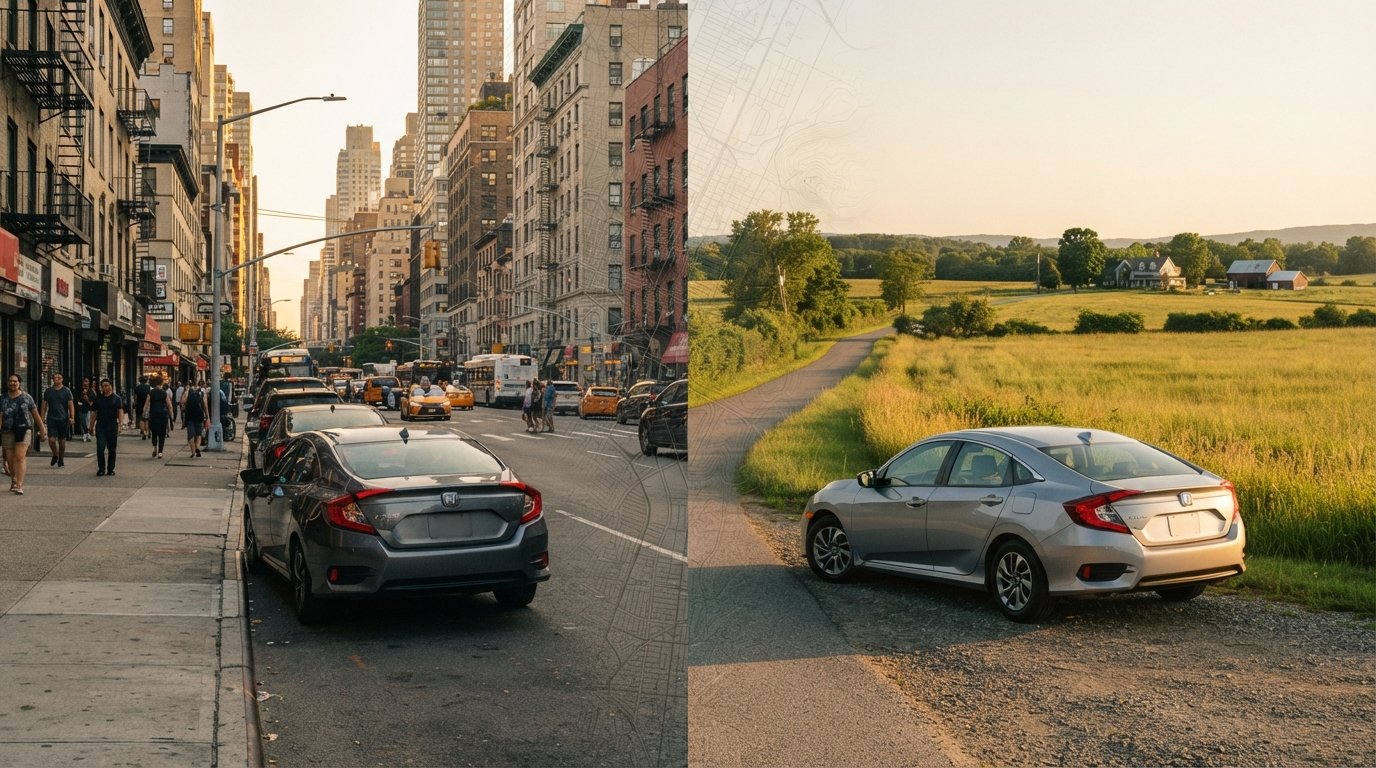
Population density and traffic volume. Areas with more cars per square mile generally see more collisions. More vehicles mean more opportunities for fender benders, rear-end crashes, and parking lot incidents. Insurers respond by assigning higher territory factors to densely populated zip codes. A downtown address with street parking and heavy commuter traffic typically carries a higher rating than a suburban cul-de-sac with driveways and lower traffic counts.
Vehicle theft rates. Comprehensive coverage pays when your car is stolen, and theft rates vary dramatically by location. Zip codes near shipping ports, major highways, or high-crime corridors often see elevated theft claims. Even if you drive a model that is not a top theft target, living in a high-theft territory can raise your comprehensive premium because the overall pool of claims in that area is larger.
Claim frequency and severity. This is the broadest factor. Insurers look at how often claims are filed in a territory and how expensive they are. Areas with a litigious culture, high repair costs, or frequent weather-related damage may see higher severity. Areas with many minor collisions may see higher frequency. Both push territory ratings upward.
These factors interact. A zip code with moderate traffic but very high theft rates might rate similarly to a zip code with heavy traffic but low theft. That is why you cannot judge your territory by one statistic alone. The insurer's filed rating reflects the combined historical experience of the entire area.
Why Rates Change After Moving Just a Few Miles
One of the most surprising lessons about how your zip code determines auto insurance costs is how sharply rates can shift over short distances. Moving from one side of a highway to the other, or from a city into an adjacent suburb, can change your premium by hundreds of dollars a year. This happens because territory boundaries do not follow your sense of neighborhood; they follow claims data.
Consider a driver who moves from a downtown apartment to a suburban home five miles away. The vehicle, the driver, and the coverage stay the same. But the downtown zip code may carry a territory factor 20 to 40 percent higher than the suburban one because of traffic density, theft, and parking-related claims. The result is a noticeably lower premium without any change in driving behavior. The reverse is also true: moving into a higher-rated territory can raise your rate even if your driving record is spotless.
State lines matter even more. Auto insurance is regulated state by state, and minimum coverage requirements, average claim costs, and legal environments differ dramatically. Moving from a rural county in one state to a suburb in another can change your rate by a wide margin because you are essentially buying a different product under different rules. This is why drivers who relocate should never assume their old premium will follow them.
Even within the same city, rating territories can be drawn at the census tract level. That means a zip code with a mix of commercial and residential streets might be split into multiple territories, and your specific address determines which one applies. Two neighbors on the same block usually share a territory, but a friend a mile away might not.
Urban, Suburban, and Rural Pricing Differences
The urban-suburban-rural divide is the clearest illustration of location-based pricing. Each environment presents a different risk profile, and insurers price accordingly.
- Urban areas typically carry the highest territory factors. Traffic congestion, limited parking, higher theft rates, and more frequent low-speed collisions all contribute. Drivers in dense city centers often pay more for the same coverage than drivers in surrounding suburbs.
- Suburban areas usually fall in the middle. Commuter traffic and highway exposure raise risk compared with rural areas, but lower density and more off-street parking reduce theft and collision frequency. Many families find suburban territories offer a reasonable balance of cost and convenience.
- Rural areas often have the lowest territory factors, but that does not guarantee the lowest premiums. Long commutes, higher speeds on rural roads, and wildlife collisions can offset the density advantage. Rural drivers may also face higher repair costs because tow distances and parts availability are worse.
These are broad patterns, not guarantees. A rural zip code near a busy interstate interchange can rate higher than a quiet suburban one. A gentrifying urban neighborhood with new secure parking garages may see theft rates fall and territory ratings improve over time. The only reliable way to know your area's rating is to compare quotes from multiple insurers, because each company draws its territories and weights its factors differently.
For drivers in the Lone Star State, regional pricing patterns add another layer, and our guide to auto insurance quotes in Texas explains how to compare rates that fit your budget across different territories.
Garaging Address Accuracy: Why Misreporting Causes Claim Problems
Your garaging address is the location where your vehicle is primarily parked overnight. Insurers use it to assign your territory rating, and it must be accurate. Misreporting it, even unintentionally, can create serious problems at claim time.
Some drivers list a relative's address in a cheaper territory while actually parking their car elsewhere. This is rating evasion, and insurers investigate it. If a claim arises and the investigation shows the vehicle was garaged at a different address, the insurer may adjust the premium retroactively, reduce the claim payout, or deny the claim entirely for material misrepresentation. The savings from a false address are never worth the risk of an unpaid claim after a serious accident.
Honest mistakes happen too. A driver who moves and forgets to update the policy, or a household that lists a student's car at the parents' address when the student keeps it at school, can end up with a garaging address that does not match reality. These errors are usually resolved with a mid-term endorsement, but they can still cause billing surprises or claim delays. The safest habit is to update your address with your insurer within days of any move and to confirm in writing which territory your policy uses.
Accuracy also protects you in another way. If your correct address places you in a lower-rated territory, you want that reflected on your policy. Underreporting your own risk does not help you; it just creates exposure. Being precise about where the car sleeps ensures your premium matches your actual situation and your coverage will respond when you need it.
How to Compare Quotes After a Move and Confirm Savings
Whether you are moving across the country or across town, a move is the single best moment to re-shop your auto insurance. Your territory rating is changing, and insurers weigh territories differently, so the company that offered the best rate at your old address may not be competitive at the new one. Follow a simple process to confirm you are getting the best available price.
- Update your address first. Contact your current insurer and report the new garaging address. Ask for the updated premium and the effective date. This gives you a baseline for comparison.
- Gather your policy details. Note your coverage limits, deductibles, and any endorsements so every quote you request uses identical terms. Comparing different coverage levels produces misleading savings.
- Request quotes from multiple carriers. Use a comparison platform to submit one form and receive quotes from several licensed agents. Each carrier applies its own territory factors, so the spread between quotes can be substantial.
- Review the territory assumptions. Confirm that each quote uses your correct garaging address and that no quote is based on an outdated zip code. Small data errors can distort the comparison.
- Check discount eligibility at the new address. Some discounts, such as garaging or low-mileage programs, depend on where and how the car is stored. Ask each agent which discounts apply at your new location.
After you have quotes in hand, compare them side by side on total annual premium, not monthly payment. A lower monthly figure with a larger down payment can cost more over the year. Also confirm that each quote includes the same deductibles and optional coverages, because a cheap quote that strips out uninsured motorist protection is not really cheaper. For independent educational context on coverage options and how location fits into the bigger pricing picture, NewAutoInsurance consumer resources offer useful background that can help you ask better questions.
If you are moving within the same state, you can often keep your current policy and simply endorse the address change. If you are moving to a new state, you will need a new policy that meets that state's minimum requirements, and you should start shopping at least two weeks before the move to avoid a coverage gap. Either way, the comparison exercise is the same: verify the address, match the coverage, and let multiple carriers compete for your business.
What You Can and Cannot Control About Location Pricing
You cannot change the traffic density of your zip code or the theft rate of your census tract. Those factors are outside your control, and no amount of safe driving will rewrite the territory rating. What you can control is how accurately your address is reported, which carrier you choose, and which discounts you claim.
Choosing the right carrier is the biggest lever. Because each insurer files its own territories and weights location differently, the same address can produce quotes that vary by hundreds of dollars. Shopping multiple carriers is the only reliable way to find the company that prices your specific territory most favorably. Accuracy is the second lever: an incorrect garaging address can cost you at claim time or cause you to miss savings you actually qualify for.
Finally, remember that location is one factor among many. Your driving record, credit-based insurance score where permitted, vehicle safety features, and coverage choices all influence your premium. Improving any of those can offset a higher territory rating. A driver in an expensive urban zip code with a clean record and a high safety-feature discount may still pay less than a driver in a cheaper territory with violations and no discounts.
Understanding how your zip code determines auto insurance costs turns a mysterious number into a manageable variable. Check your garaging address, compare quotes after every move, and let competition among carriers do the rest. A few minutes of comparison can confirm whether your location is costing you more than it should and put those savings back where they belong.