
Understanding Liability Auto Insurance: Legal Protection on the Road
Liability auto insurance protects your finances if you cause an accident. Adequate coverage shields your assets from lawsuits for property damage and bodily injury claims.

By Lucas Bennett
When you get behind the wheel, you are taking on a significant legal and financial responsibility. A momentary lapse in judgment or a simple mistake can lead to an accident, leaving you facing potentially devastating bills for someone else’s medical treatment, lost wages, and vehicle repairs. This is where liability auto insurance becomes your first and most crucial line of defense. It is not just a policy, it is a legal requirement in most states, designed to protect your personal assets from being seized to pay for damages you cause to others. Without it, a single at-fault accident could lead to financial ruin, making understanding this coverage essential for every driver.
The Core Components of Auto Liability Insurance
Automobile liability insurance is broken down into two primary coverage types, each denoted by a split limit on your policy (e.g., 100/300/50). These work together to cover costs for which you are found legally responsible after an accident. The first component is bodily injury liability. This coverage pays for medical expenses, rehabilitation costs, lost income, and even legal fees and pain and suffering for other people injured in an accident you cause. It does not cover your own injuries. The second is property damage liability. This pays to repair or replace another person’s property that you damage with your vehicle. This most commonly means another car, but it can also cover objects like fences, mailboxes, light poles, or storefronts.
Understanding policy limits is critical. A common limit structure is expressed as three numbers: 100/300/50. In this example, “100” means your insurer will pay up to $100,000 per person for bodily injury. “300” is the total maximum the insurer will pay for all bodily injuries in a single accident. “50” represents the maximum payout for all property damage in that accident. Choosing limits based solely on your state’s minimum requirement is often a significant financial risk, as a serious accident can easily exceed those low amounts, leaving you personally liable for the difference. For a deeper look at how these core coverages function in different contexts, our article on commercial auto liability insurance core coverage explains the principles in detail.
Why Liability Coverage Is a Non-Negotiable Requirement
Liability insurance serves a dual purpose: protecting you and protecting society. From a legal standpoint, nearly every state has enacted financial responsibility laws mandating a minimum amount of liability coverage to register and operate a vehicle legally. Driving without it can result in severe penalties, including fines, license suspension, vehicle impoundment, and even jail time for repeat offenses. More importantly, from a financial perspective, it shields your personal wealth. If you cause an accident and are underinsured or uninsured, the injured party can sue you for damages beyond what your policy covers. A court judgment could lead to wage garnishment, liens placed on your home or other assets, and a depleted savings account.
The societal benefit is equally important. This system ensures that victims of car accidents have a reliable source of compensation for their losses, regardless of the at-fault driver’s personal wealth. It creates a pool of funds to handle medical bills and property repairs, helping injured parties recover without shouldering impossible debt. This foundational concept applies whether you drive a personal car or a business vehicle, which is why understanding why you need commercial auto liability insurance is vital for anyone using a vehicle for work.
Determining How Much Liability Insurance You Truly Need
Selecting your liability limits is one of the most important financial decisions you will make regarding your auto policy. State minimums, such as 25/50/25, are often dangerously low. The costs associated with a multi-vehicle crash with serious injuries can soar into the hundreds of thousands of dollars in moments. A robust liability policy is a key component of a sound personal financial plan. To determine adequate coverage, you should conduct a personal asset assessment. Consider the total value of your assets that could be at risk in a lawsuit: your home equity, savings, investment accounts, and future income. Your liability limits should be high enough to protect these assets from seizure.
Consider these factors when choosing your limits:
- Your Net Worth: Higher net worth typically necessitates higher limits to protect your accummulated wealth.
- Your Driving Environment: Dense urban traffic with higher-value vehicles and greater accident frequency may warrant more coverage than rural driving.
- Future Earnings Potential: A court can garnish your future wages. Professionals with high earning potential should consider umbrella liability insurance, which provides excess coverage above your auto and home policy limits.
- Risk Tolerance: Are you comfortable with the risk of a gap between your coverage and a potential judgment? Increasing limits provides peace of mind.
An insurance agent can provide valuable guidance, but the ultimate responsibility lies with you. It is generally recommended to carry liability limits that meet or exceed your total net worth. For business owners, this assessment is even more critical, as a company vehicle accident can expose both business and personal assets. Identifying who needs commercial auto liability insurance is the first step in securing appropriate protection.
How Liability Insurance Works in a Real Accident Scenario
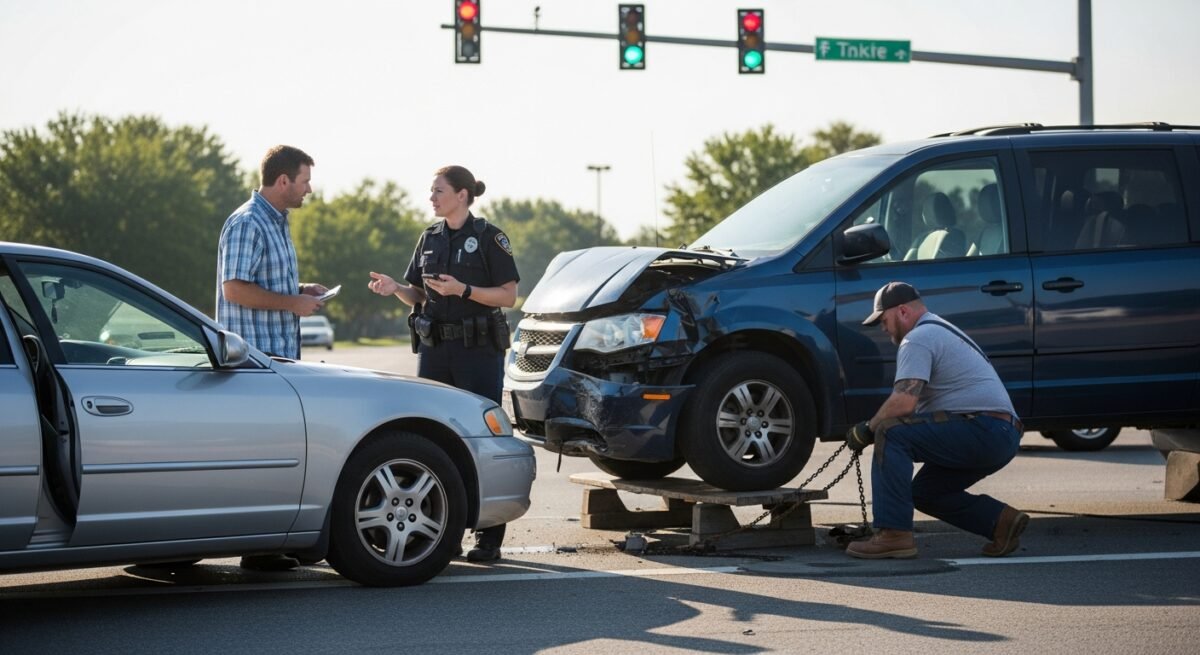
Imagine you run a red light and collide with another vehicle, injuring the driver and a passenger, and totaling their car. After the police report determines you are at fault, the claims process begins. The injured parties will file a claim against your liability auto insurance. Your insurance company will then investigate the claim, which includes reviewing the police report, assessing vehicle damage, and evaluating medical records. An adjuster will work to settle the claim within your policy limits. For instance, if you have 100/300/50 coverage and the total medical bills are $150,000 ($80,000 for the driver, $70,000 for the passenger) and property damage is $40,000, your policy would cover it all, as each component is under its respective per-person, per-accident, and property maximums.
Your role is to report the accident promptly and cooperate with your insurer’s investigation. The insurer handles negotiations, legal defense if a lawsuit is filed, and issues payment up to your policy limits. This protection is why paying your premium is worthwhile: it transfers a massive, unpredictable financial risk to the insurance company. For complex cases or high-value claims, having expert resources is invaluable. You can find detailed analysis on similar scenarios and broader insurance topics if you Read full article on our dedicated resource site.
Common Misconceptions and Critical Exclusions
Many drivers operate under dangerous misunderstandings about what their liability insurance covers. A critical point to remember is that liability insurance does not cover you or your vehicle. Your own medical bills would be covered by personal injury protection (PIP) or medical payments coverage, and damage to your car is covered by collision insurance. Furthermore, liability insurance will not cover intentional damage or accidents that occur while you are using your vehicle for a ride-sharing service like Uber or Lyft without a proper endorsement. It also typically excludes accidents that happen while you are driving for a delivery service not listed on your policy, highlighting the gap between personal and commercial use.
Another major misconception involves “full coverage.” This is not a technical insurance term. It generally refers to a policy that includes liability plus comprehensive and collision coverages. However, even a “full coverage” policy with low liability limits leaves you exposed to lawsuits for damages above those limits. Always scrutinize the numbers on the liability portion of your policy declaration page. Do not assume you are fully protected simply because you have multiple coverage types.
Frequently Asked Questions About Auto Liability Insurance
Is liability insurance enough by itself?
While it meets legal minimums, it only covers others’ losses. For full financial protection, you should strongly consider adding comprehensive and collision coverage for your own vehicle, plus uninsured/underinsured motorist coverage.
What happens if the damage I cause exceeds my policy limits?
You are personally responsible for the amount exceeding your limits. The injured party can sue you, and a court can order you to pay the difference from your personal assets and future income.
Does liability insurance follow the car or the driver?
In most cases, auto liability insurance follows the vehicle. If you let someone else drive your insured car and they cause an accident, your liability insurance is typically primary. There are exceptions, so check your policy.
How can I lower my liability insurance premium?
Maintaining a clean driving record, choosing higher deductibles for other coverages, bundling with home insurance, asking about discounts (good student, safe driver), and occasionally shopping around with different insurers can help reduce costs.
What is the difference between liability insurance and full coverage?
Liability insurance covers damage you cause to others. “Full coverage” is a colloquial term that usually means liability insurance plus comprehensive and collision coverages, which protect your own vehicle from various risks.
Securing robust liability auto insurance is not merely about checking a legal box, it is a proactive step in safeguarding your financial future. The relatively modest cost of increased coverage limits pales in comparison to the life-altering financial burden of a major at-fault accident. Regularly review your policy, especially after major life events like buying a home, receiving a promotion, or starting a business that uses vehicles. Make an informed choice about your limits based on your asset profile and risk exposure, ensuring that your policy acts as a true shield, preserving the financial stability you have worked hard to build.