
What Is Auto Gap Insurance? How It Protects Your Loan
Gap insurance auto coverage protects you from owing thousands after a car is totaled. It covers the difference between your loan balance and your car’s depreciated value.

By Lucas Bennett
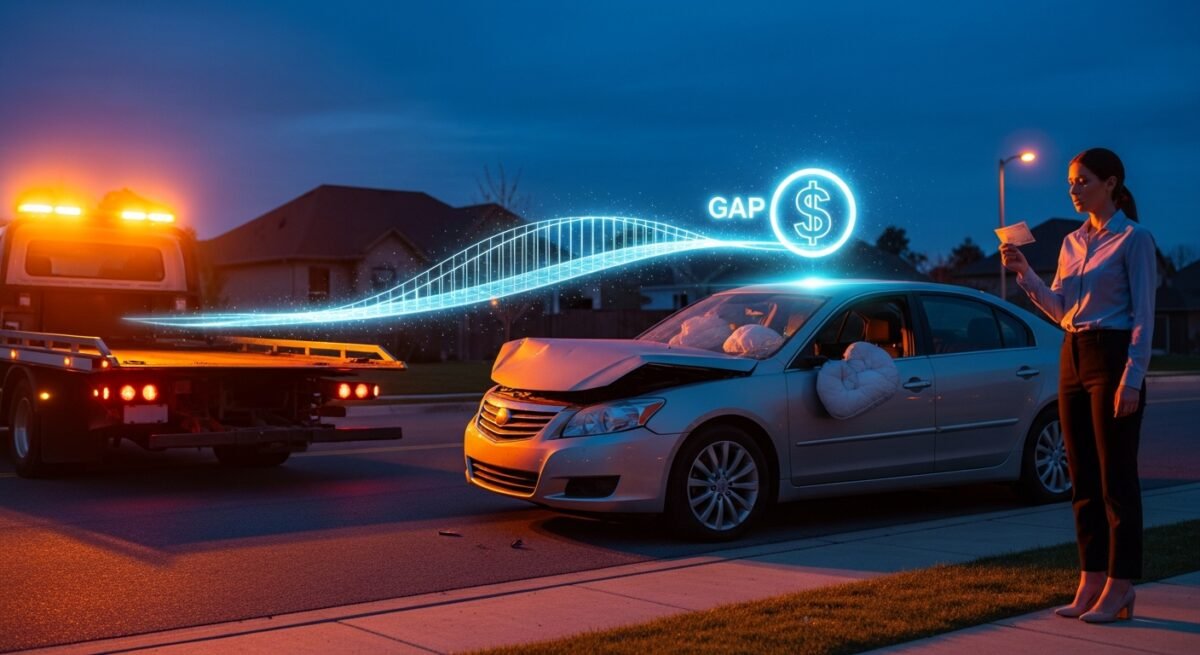
You just drove your brand new car off the lot, and a month later, it’s totaled in an accident. You file a claim with your auto insurance company, expecting them to cover the cost of your new vehicle. The check arrives, and your heart sinks. The payment is thousands of dollars less than the amount you still owe on your auto loan. This devastating scenario, known as being “upside down” on your loan, is a common financial pitfall for new car buyers. Fortunately, a specific type of coverage exists solely to bridge this dangerous financial gap: Guaranteed Asset Protection, or gap insurance.
Gap insurance auto coverage is not a standard part of a typical auto insurance policy. Instead, it is a specialized, optional add-on designed to protect borrowers from a specific and costly risk. When you finance or lease a new or nearly new vehicle, depreciation works against you immediately. The moment you drive away, the car’s market value begins to drop, often sharply in the first few years. Your comprehensive and collision insurance, however, only covers the car’s actual cash value (ACV) at the time of the loss, not the original purchase price or the loan balance. If your loan balance is higher than the car’s depreciated value, you are responsible for that difference. Gap insurance pays that difference, protecting you from having to write a large check to your lender for a car you can no longer drive.
Understanding How Auto Gap Insurance Works
The mechanics of gap insurance are straightforward, but they highlight a critical flaw in relying solely on standard auto coverage after a total loss. Let’s illustrate with a concrete example. Suppose you purchase a new car for $35,000. You make a down payment of $3,500 and finance the remaining $31,500. After one year and 15,000 miles, your car is stolen and not recovered. You file a claim with your insurer. They determine the actual cash value of your car at the time of theft, considering its age, mileage, and condition, is now only $27,000. Your primary auto insurance policy will pay you that $27,000, minus your deductible. However, you still owe $29,000 on your loan. After applying the insurance payout, you are left with a $2,000 shortfall, plus your deductible, that you must pay out of pocket.
This is where gap insurance auto coverage activates. It would cover that $2,000 gap between the ACV payment and your outstanding loan balance. Many gap policies also cover your comprehensive/collision deductible, meaning you could be made whole on the loan without any out-of-pocket expense. Without gap coverage, you would be forced to pay the lender the remaining balance, potentially requiring a personal loan while also needing funds for a new vehicle down payment. This financial double-whammy is what makes gap insurance a crucial consideration for many buyers.
Who Really Needs Gap Insurance?
Gap insurance is not a universal requirement for every driver. Its necessity is directly tied to your financial position relative to your vehicle’s value. Evaluating your need involves a clear assessment of your loan terms and the asset’s depreciation curve.
You are a strong candidate for gap insurance if you meet several of the following criteria: you made a low down payment (typically less than 20%), you financed the vehicle for a long term (72 or 84 months), you leased the vehicle (most leases require it), you purchased a vehicle that depreciates rapidly, or you rolled negative equity from a previous loan into your new one. Each of these factors increases the likelihood that your loan balance will outpace the decline in your car’s actual cash value, creating a gap.
Conversely, you may not need gap insurance if you made a substantial down payment (over 20%), you have a short loan term (36 or 48 months), or you are purchasing a vehicle known for strong residual value (like certain trucks or hybrids). As you make payments over time, the loan principal decreases. Once the point arrives where your loan balance falls below the car’s projected market value, you can safely cancel your gap insurance policy. This moment is often referred to as being “right-side up.”
Key Situations Where Gap Coverage Is Essential
Beyond the general guidelines, certain high-risk scenarios make gap protection almost non-negotiable. Leasing is the premier example. Lease agreements are structured around the car’s predicted future value, or residual value. If the car is totaled, the leasing company expects payment for the remaining lease payments plus the residual value. Standard insurance only covers the current market value, which is often less than this total amount. Therefore, virtually all leasing companies mandate lessees carry gap insurance, often offering it directly through the finance company. Another critical situation involves rolling over negative equity. If you traded in a car you owed money on, and the dealer added that old debt to your new loan, you are starting your ownership journey already upside down. Gap insurance is vital to dig yourself out of that initial hole in the event of a total loss.
Where and How to Purchase Gap Insurance
Consumers have three primary avenues for purchasing gap insurance: through your auto lender/finance company, directly from your auto insurance carrier, or through a specialized third-party provider. Each source has distinct advantages and potential drawbacks that affect both cost and convenience.
Purchasing gap insurance from your car dealer or lender at the time of financing is common, but it is often the most expensive option. The cost is typically rolled into your loan amount, which means you will pay interest on it over the life of the loan, increasing the total cost. However, it is convenient and seamlessly integrated. Buying gap coverage from your existing auto insurance company is frequently the most cost-effective method. It is purchased as an endorsement (rider) to your policy, billed monthly or semi-annually with your premium, and does not accrue interest. A key benefit here is that you can cancel it at any time with a simple phone call once the gap risk has passed. Third-party specialty providers can also offer competitive rates, but it is crucial to research their reputation and claims-paying ability thoroughly.
When comparing options, focus on the total premium cost, not the monthly payment added to a loan. Ask specific questions about coverage details: Does the policy cover the full gap? Does it include the deductible? Are there any caps or limits on the payout? Understanding the fine print ensures you are buying a policy that fully protects you.
The Cost and Value Proposition of Gap Coverage
The cost of gap insurance is relatively low compared to the financial risk it mitigates. When purchased through an auto insurer, it typically adds only $20 to $40 per year to your premium, or roughly $2 to $4 per month. When purchased through a dealer or lender, the lump-sum cost can range from $400 to $800, though this one-time fee is financed and interest-bearing. While this may seem like an unnecessary expense, its value becomes starkly clear in a total loss scenario. Paying a few hundred dollars over the loan’s life to avoid a surprise bill of several thousand dollars is a prudent financial trade-off for those at risk.
It is a form of financial safety net with a very specific purpose. You are not insuring the car itself, you are insuring your loan balance against the inefficiencies of depreciation and standard insurance settlements. For the right buyer, it provides peace of mind and financial stability, ensuring a single accident does not lead to long-term debt for an asset you no longer possess. For a deeper dive into comparing costs and policy structures from different providers, Read full article for a detailed analysis.
Frequently Asked Questions About Gap Insurance
Does gap insurance cover a stolen car?
Yes. If your car is stolen and not recovered, it is treated as a total loss by your comprehensive insurance. Gap insurance would cover the difference between the comprehensive payout and your loan or lease balance.
Will gap insurance cover my down payment if my car is totaled?
No. Gap insurance does not reimburse you for your initial down payment or any equity you had in the vehicle. It only covers the shortfall between the insurance settlement and the amount you owe the lender.
Can I cancel gap insurance once I no longer need it?
Yes, and you should. If you purchased it from your auto insurer, you can cancel at any time and will receive a pro-rated refund for the unused portion of the premium. If you purchased it through your lender and paid a lump sum, you may be eligible for a refund if you cancel early, but policies vary. Check your contract.
Is gap insurance required by law?
No, gap insurance is not legally mandated by any state. However, it is frequently required by contract if you are leasing a vehicle.
Does gap insurance cover mechanical failure or an accident where the car is repaired?
Absolutely not. Gap insurance only applies in a total loss situation, where the car is deemed a total loss by your primary auto insurer. It does not apply to repair bills, routine maintenance, or mechanical breakdowns.
Ultimately, auto gap insurance is a targeted financial tool for a specific phase of car ownership. It addresses the vulnerable period when you are most exposed to the steepest depreciation. By understanding your loan structure, your vehicle’s depreciation rate, and your own financial resilience, you can make an informed decision on whether this coverage is a necessary safeguard or an unnecessary expense. For most borrowers with long terms, small down payments, or leased vehicles, the modest annual cost provides a critical layer of protection against a potentially catastrophic financial setback, ensuring that a total loss remains an inconvenience, not a lasting debt.