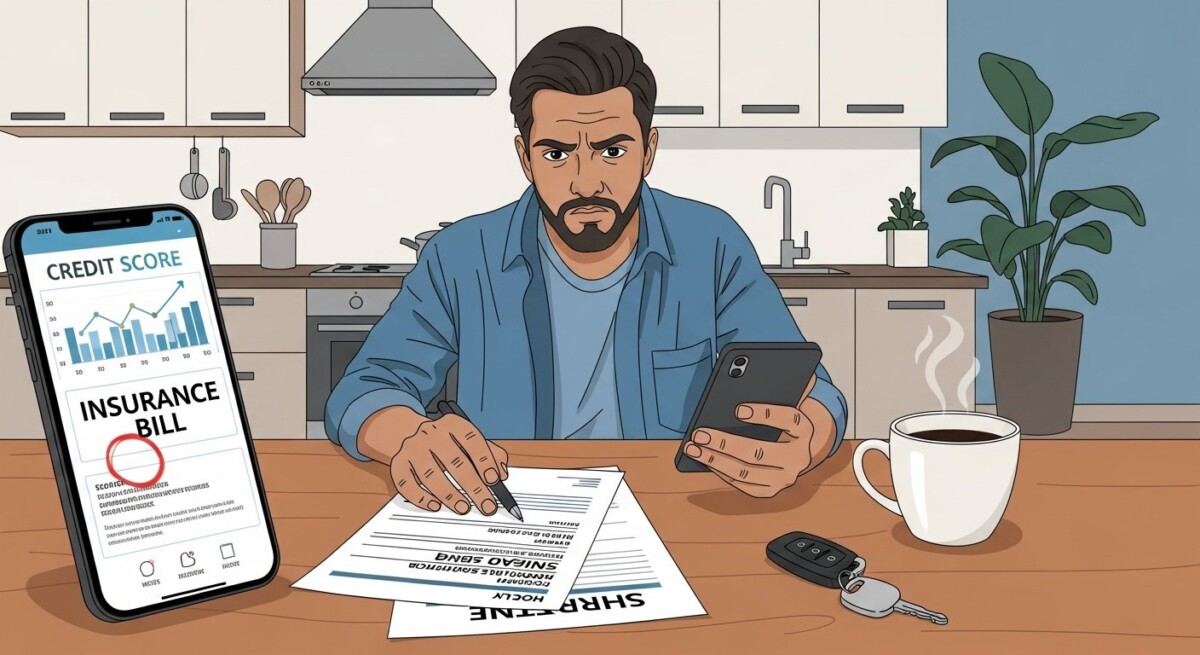
If you have a low credit score, you already know that everyday expenses can feel heavier. But what you might not realize is how dramatically your credit history can affect your auto insurance rates. Insurers in most states use credit-based insurance scores to set premiums, and a lower score can mean paying hundreds more per year for the same coverage. The question is not whether you can find coverage, but rather what is the best auto insurance if you have a low credit score. The answer involves knowing which carriers weigh credit less heavily, which discounts can offset the penalty, and how to structure your policy for maximum savings. This guide walks you through each of those steps so you can get behind the wheel with confidence and a fair rate.
How Credit Scores Affect Auto Insurance Premiums
Insurance companies have spent decades analyzing data to predict risk. One of their strongest predictors is the credit-based insurance score, which correlates closely with the likelihood of filing a claim. Studies by the Federal Trade Commission and various state insurance departments have confirmed that drivers with lower credit scores tend to file more claims, and those claims tend to be more expensive. As a result, insurers charge higher premiums to offset that risk. The difference can be stark. A driver with excellent credit might pay $1,200 per year for full coverage, while a driver with a poor credit score could pay $2,400 or more for the same policy from the same company. This reality makes it essential to shop around, because each insurer uses its own formula to weigh credit. Some carriers penalize low credit heavily, while others treat it as just one factor among many. Understanding this landscape is the first step toward finding a policy that does not break your budget.
Which Insurers Are Best for Drivers With Low Credit
Not all auto insurers view credit scores the same way. Some companies specialize in working with high-risk drivers, while others offer programs that can reduce the impact of a low score. Based on market analysis and consumer data, the following carriers tend to offer more competitive rates for drivers with less-than-perfect credit.
Progressive
Progressive is known for its willingness to insure drivers with a variety of credit profiles. The company uses credit as a factor, but it also offers several discounts that can help lower your premium regardless of your score. For example, you can save by bundling your auto policy with renters or homeowners insurance, signing up for paperless billing, or paying your premium in full upfront. Progressive’s Name Your Price tool lets you set a budget, and the system shows you coverage options that fit within it. This feature is especially useful if you are working with a tight monthly budget but still need solid protection.
GEICO
GEICO tends to offer lower base rates than many competitors, which can help offset the surcharge for low credit. The company also provides a wide range of discounts, including good driver discounts, multi-vehicle discounts, and discounts for federal employees or military members. GEICO’s financial strength is excellent, so you can feel confident that claims will be paid promptly. If you have a low credit score but a clean driving record, GEICO is often a strong contender for the best auto insurance for your situation.
State Farm
State Farm is the largest auto insurer in the United States, and it uses a more holistic approach to underwriting. While credit is a factor, State Farm also heavily weighs your driving history, the type of vehicle you drive, and your annual mileage. If you can demonstrate low risk through safe driving and low mileage, your credit score may have less impact on your final rate. State Farm also offers a Drive Safe & Save program that uses telematics to monitor your driving habits, potentially lowering your premium if you drive safely.
USAA
If you are a current or former member of the military, or a family member of one, USAA is often the best option regardless of your credit score. USAA consistently ranks at the top of customer satisfaction surveys and often provides rates that are significantly lower than the competition, even for drivers with low credit. The company offers a variety of discounts and financial products that can help you manage your overall insurance costs.
How to Compare Quotes Effectively
Getting the right rate requires more than just picking a company from a list. You need to compare quotes side by side, and you need to make sure you are comparing the same coverage limits and deductibles. Here is a step-by-step approach to finding the best auto insurance if you have a low credit score.
- Gather your information. Have your driver’s license number, vehicle identification number (VIN), current odometer reading, and details about your driving history ready. This will speed up the quote process and ensure accuracy.
- Request quotes from at least five companies. Include the carriers mentioned above plus at least one or two smaller regional insurers. Regional companies sometimes offer more personalized rates.
- Use the same coverage limits. For a fair comparison, set the same liability limits, comprehensive and collision deductibles, and add-on coverages for each quote. If you are unsure what limits you need, start with the minimum requirements for your state and then consider increasing them if the quotes are affordable.
- Look for discounts. Ask each company about available discounts. Common ones include multi-policy, multi-vehicle, good student, defensive driving course, and low-mileage discounts. Some companies also offer discounts for paying in full or setting up automatic payments.
- Check the financial strength rating. Use resources like A.M. Best or Standard & Poor’s to verify that the insurer is financially stable. A low rate is not a good deal if the company cannot pay your claim.
Once you have a few competitive quotes, look beyond the monthly payment. Consider the customer service reputation, claims process, and whether the insurer offers features like accident forgiveness or roadside assistance. In our guide on Auto Insurance Michigan: Low Rates and Reliable Coverage, we explain how state-specific factors can also influence your options and costs.
Discounts That Help Offset a Low Credit Score
Even if your credit score is low, you can still qualify for many discounts that reduce your premium. The key is knowing which discounts are available and how to meet the requirements. The following list covers some of the most effective discounts for drivers with less-than-perfect credit.
- Multi-policy discount. Bundling your auto insurance with a renters, condo, or homeowners policy can save you 10 to 25 percent on both policies. This is often the single largest discount available.
- Pay-in-full discount. If you can afford to pay your entire six-month or annual premium upfront, many insurers will reduce your total cost by 5 to 10 percent. This also eliminates monthly installment fees.
- Safe driver discount. A clean driving record with no accidents or moving violations for three to five years can earn you a significant discount, sometimes reducing your premium by 20 percent or more.
- Low-mileage discount. If you drive fewer than 7,500 miles per year, you may qualify for a low-mileage discount. Some insurers also offer usage-based programs that track your driving and reward safe, low-mileage habits.
- Defensive driving course discount. Completing an approved defensive driving course can lower your premium by 5 to 15 percent. This is especially helpful if you have a low credit score because it demonstrates proactive risk reduction.
Combining several of these discounts can substantially reduce the impact of a low credit score. For example, bundling your policies, paying in full, and completing a defensive driving course could save you 20 to 30 percent off the base rate. That can make the difference between an unaffordable policy and one that fits comfortably in your budget. If you are shopping in a specific region, check our article on Auto Insurance Delaware: Trusted Providers and Low Rates for state-specific discount opportunities.
Coverage Options to Consider
When you have a low credit score, you might be tempted to buy only the minimum liability coverage required by your state. While that will give you the lowest monthly payment, it can leave you financially vulnerable if you cause an accident. Medical bills, vehicle repairs, and legal fees can quickly exceed minimum limits, and you could be sued for the difference. A better approach is to find a balance between affordability and adequate protection. Here are the key coverage types to evaluate.
Liability coverage. This pays for injuries and property damage you cause to others. Most states require a minimum amount, but experts recommend carrying at least $100,000 per person and $300,000 per accident for bodily injury, plus $100,000 for property damage. If your state requires lower limits, consider raising them if the cost is manageable.
Comprehensive and collision. Comprehensive covers damage from non-collision events like theft, vandalism, hail, and animal strikes. Collision covers damage from hitting another vehicle or object. If your car is older and has a low market value, you might drop these coverages to save money. A general rule is to drop comprehensive and collision when the annual premium for these coverages exceeds 10 percent of the car’s value.
Uninsured/underinsured motorist coverage. This covers your injuries if you are hit by a driver who has no insurance or insufficient insurance. It is required in some states and highly recommended in all states. The cost is usually low, and the protection is valuable.
Medical payments or personal injury protection (PIP). These cover medical expenses for you and your passengers regardless of who caused the accident. PIP is required in no-fault states, while medical payments is optional in most others. If you have health insurance, you may not need high limits, but a small amount can help cover deductibles and copays.
Choosing the right mix of coverage limits and deductibles can lower your premium without leaving you exposed. For example, raising your deductible from $500 to $1,000 can reduce your collision and comprehensive premium by 15 to 30 percent. Just make sure you have that amount set aside in an emergency fund. For more on tailoring coverage to your situation, see A Complete Guide to Auto Insurance in Massachusetts for Drivers, which covers similar decision-making principles that apply nationwide.
Improving Your Credit Score Over Time
While finding the best auto insurance for a low credit score is important today, you can also take steps to improve your credit score over the long term. A higher score will open up lower rates and more options when you shop for insurance in the future. Here are some practical strategies.
Pay your bills on time. Payment history is the most important factor in your credit score. Set up automatic payments or calendar reminders to ensure you never miss a due date. Even one late payment can drop your score by 60 to 110 points.
Reduce your credit utilization. This is the amount of credit you are using compared to your total credit limit. Aim to keep your utilization below 30 percent. For example, if you have a credit card with a $5,000 limit, try to keep the balance under $1,500. Paying down high balances can improve your score within a few months.
Check your credit reports for errors. You are entitled to a free credit report from each of the three major bureaus (Equifax, Experian, and TransUnion) once per year at AnnualCreditReport.com. Look for incorrect account information, fraudulent accounts, or outdated negative items. Disputing errors can lead to a quick score increase.
Limit new credit applications. Each time you apply for credit, a hard inquiry appears on your report and can temporarily lower your score by a few points. Only apply for new credit when necessary, and space out applications by at least six months.
As your credit score improves, you can request a re-rate from your current insurer or shop for a new policy that reflects your lower risk profile. Some insurers will re-evaluate your rate every six or twelve months, but you can also proactively ask for a review. For more details on how credit and other factors influence rates, read Auto Insurance Kentucky: Get Reliable Coverage at Low Rates, which discusses similar rating factors.
Frequently Asked Questions
Can I get auto insurance with a low credit score?
Yes, you can absolutely get auto insurance with a low credit score. While some insurers may charge higher premiums, many companies are willing to insure drivers with less-than-perfect credit. The key is to compare quotes from multiple carriers and take advantage of available discounts. Some states, such as California, Hawaii, Massachusetts, and Michigan, restrict or prohibit the use of credit scores in insurance pricing, which can work in your favor if you live in one of those states.
How much more will I pay for insurance with bad credit?
The surcharge for low credit varies by insurer and state. On average, drivers with poor credit pay about 50 to 100 percent more than drivers with excellent credit for the same coverage. In some cases, the difference can be even larger. Shopping around is critical because one insurer may charge you $1,800 per year while another charges $2,800 for the same policy. Using a comparison platform like Free Auto Insurance Quotes Online can help you see multiple rates at once.
Will my credit score affect my insurance if I live in a state that bans credit scoring?
If you live in California, Hawaii, Massachusetts, or Michigan, insurers are generally prohibited from using credit-based insurance scores to set rates. In those states, your credit score will not directly affect your premium. However, insurers may still consider other factors like your driving record, age, vehicle type, and location. If you live in one of these states, you may have an easier time finding affordable coverage regardless of your credit history.
Does paying my insurance premium on time improve my credit score?
Paying your auto insurance premium on time does not directly affect your credit score because insurance companies typically do not report payment history to the credit bureaus. However, if you fall behind on payments and the account is sent to a collection agency, that collection account could appear on your credit report and damage your score. So while on-time payments do not help your credit, late payments that go to collections can hurt it significantly.
What is the best auto insurance if you have a low credit score and a recent accident?
If you have both a low credit score and a recent accident, you are considered a high-risk driver. In this situation, insurers like Progressive, GEICO, and State Farm are still good options, but you may also want to look at companies that specialize in non-standard insurance, such as The General, Dairyland, or SafeAuto. These companies often have more lenient underwriting guidelines, though their rates may be higher. Working with an independent agent who can shop multiple carriers on your behalf can also help you find the best rate.
Finding the best auto insurance when your credit score is low takes a little extra effort, but it is entirely possible. By understanding how insurers use credit, comparing quotes from multiple companies, stacking discounts, and choosing the right coverage levels, you can secure a policy that protects you and fits your budget. Your credit score does not define your worth as a driver, and with the right approach, it does not have to define your insurance rate either. Start your comparison today at Free Auto Insurance Quotes Online to see how much you can save.