
Collision and Comprehensive Deductibles on One Claim
See how collision and comprehensive deductibles apply separately on one claim. Call (833)-275-7533 to confirm your deductible details with a licensed agent.

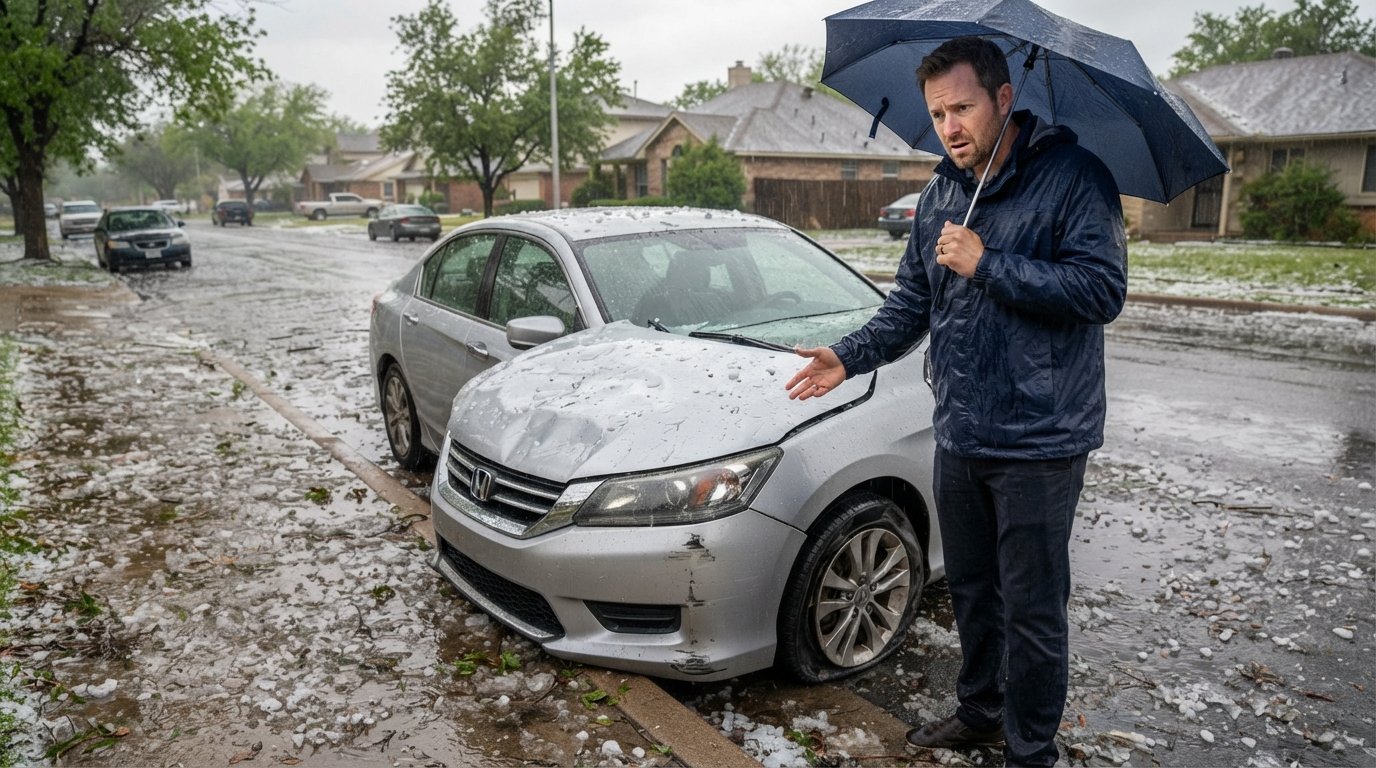
Your car crunches against a curb during a sudden hailstorm. The hail dimples the hood and roof, while the curb strike bends a wheel and scrapes the bumper. You file a claim, expecting one deductible. Then your insurer explains that collision and comprehensive are separate coverages, each with its own deductible, and you may be looking at two separate charges. That moment of confusion is common, and it is exactly why understanding how these two deductibles interact matters before you ever need to file a claim.
Collision and comprehensive are the two physical damage coverages on a standard auto policy. Collision pays for damage to your car from hitting another vehicle or object, or from a rollover. Comprehensive pays for damage from causes other than collision, such as theft, fire, vandalism, hail, flood, or animal strikes. Each coverage carries its own deductible, and each deductible applies separately when a claim is filed under that coverage. How they work together on a single claim depends on whether one event triggers both coverages or whether the damage is attributed to a single cause.
Separate Coverages, Separate Deductibles
Every auto insurance policy lists deductibles for collision and comprehensive as distinct line items. You might choose a $500 collision deductible and a $250 comprehensive deductible, or $1,000 for both, or any combination your insurer offers. The deductible is the amount you pay out of pocket before the insurer pays the rest of a covered claim, up to the policy limit. Because the coverages are separate, the deductible for one does not automatically apply to the other.
When you file a claim, the adjuster first determines which coverage applies to the damage. If a deer runs into your car, that is a comprehensive claim, and your comprehensive deductible applies. If you back into a mailbox, that is a collision claim, and your collision deductible applies. The two deductibles do not merge or offset each other. They are separate cost-sharing amounts tied to separate coverage parts.
This separation is why drivers sometimes pay two deductibles on what feels like a single incident. The key is whether the damage can be attributed to two distinct causes that fall under different coverages. If a single event causes damage that only one coverage covers, you pay one deductible. If a single event produces damage that clearly falls under both coverages, the insurer may treat it as two claims with two deductibles. The next section walks through a concrete scenario to show how that plays out.
A Hailstorm Plus Curb Strike Scenario
Imagine you are driving through a neighborhood when a sudden hailstorm hits. You pull to the side of the road, but in the process your front tire strikes a curb, bending the wheel and scraping the lower bumper. The hail dents your hood, roof, and trunk lid. You file a claim for all the damage. The insurer inspects the car and separates the damage into two categories: hail damage and curb impact damage.
The hail damage falls under comprehensive coverage because hail is a listed comprehensive peril. The curb strike falls under collision coverage because hitting a curb is a collision with an object. The insurer applies your comprehensive deductible to the hail damage and your collision deductible to the curb damage. If you have a $500 comprehensive deductible and a $1,000 collision deductible, you pay $500 toward the hail repair and $1,000 toward the curb repair, for a total out-of-pocket of $1,500, assuming both repairs exceed the deductibles.
Now consider a variation. What if the hail damage is minor and the repair estimate is $400, which is below your $500 comprehensive deductible? In that case, the comprehensive portion of the claim pays nothing because the damage does not exceed the deductible. You would pay the full $400 out of pocket for the hail repair, and the collision deductible would still apply to the curb damage. This illustrates that a deductible is not just a fee; it is a threshold that determines whether insurance pays anything at all for that portion of the loss.
Another variation: what if the curb strike happens first, and then while your car is parked waiting for a tow, a hailstorm damages it? The two events are separate occurrences. The collision claim for the curb strike would be handled under collision coverage with its deductible, and the comprehensive claim for the hail would be handled under comprehensive coverage with its deductible. Two occurrences, two claims, two deductibles. The timing and cause matter.
One Deductible or Two When a Single Event Triggers Both Coverages
The most common point of confusion is whether a single event that damages a car in multiple ways requires one deductible or two. The answer depends on how the insurer classifies the cause of loss. If the event is a single cause that falls under one coverage, you pay one deductible. If the event produces damage from two distinct causes that fall under different coverages, the insurer may apply two deductibles.
Many insurers treat a single event with a single proximate cause as one claim. For example, if a tornado lifts your car and slams it into a tree, the entire loss might be classified as a comprehensive claim (wind and falling object) rather than a collision claim, even though the car hit a tree. The insurer looks at the dominant cause of the loss. In that case, only the comprehensive deductible applies. Similarly, if a flood floats your car into another vehicle, the loss is typically comprehensive because the flood is the proximate cause, and the collision with the other vehicle is secondary.
However, when the damage is clearly divisible into separate causes, insurers often apply separate deductibles. The hailstorm plus curb strike is a classic example because the hail damage and the curb damage are physically distinct and caused by different perils. The adjuster can point to specific damage from hail and specific damage from the curb impact. In that situation, two deductibles are common.
Policy language and state regulations can influence the outcome. Some policies include a clause stating that if a single occurrence involves more than one coverage, the insurer will not apply more than one deductible. Others are silent, leaving the insurer to apply standard claims handling practices. If you are unsure how your policy handles this, ask your agent or read the deductible section of your policy carefully. The difference between one deductible and two can be hundreds or thousands of dollars.
How Different Deductible Amounts Change Your Premium Tradeoffs
Choosing different deductible amounts for collision and comprehensive is a common way to balance premium cost against out-of-pocket risk. A higher deductible generally lowers your premium because you are taking on more of the financial risk. A lower deductible raises your premium but reduces what you pay when you file a claim. Because collision and comprehensive are priced separately, you can set them independently.
Here is how the tradeoff typically works in practice:
- High collision, low comprehensive: You save on premium if you are a safe driver who rarely causes collisions, but you keep comprehensive low because theft, hail, or vandalism are unpredictable and can happen to anyone.
- Low collision, high comprehensive: You keep collision low if you drive in dense traffic where fender benders are more likely, but you accept more out-of-pocket risk for weather or theft claims.
- High both: You minimize premium, but you need enough savings to cover both deductibles if a single event triggers both coverages.
- Low both: You maximize protection, but you pay more in premium every month, even in years when you file no claims.
The right combination depends on your budget, your driving environment, and your risk tolerance. If you live in an area prone to hail or flooding, a lower comprehensive deductible may be worth the extra premium. If you commute in heavy traffic, a lower collision deductible may make sense. The key is to avoid choosing deductibles so high that you cannot afford to pay them when a claim arises, especially if a single event could trigger both.
When you request quotes, ask the agent to show you the premium impact of different deductible combinations. A $250 difference in deductible might change your premium by only a few dollars per month, or it might be substantial, depending on the insurer and your profile. Seeing the numbers side by side makes the tradeoff concrete. For a deeper look at how deductibles work in general and how to choose one, see our guide on how auto insurance deductibles work.
Practical Steps When You File a Claim Involving Both Coverages
If you find yourself in a situation where damage could fall under both collision and comprehensive, a few practical steps can help you navigate the claims process. First, document the damage thoroughly. Take photos from multiple angles and note the weather conditions, the sequence of events, and any other details that explain how the damage occurred. This documentation helps the adjuster classify the damage correctly.
Second, ask the adjuster to explain how the claim will be split. Specifically, ask whether the insurer will apply one deductible or two, and why. If the damage is clearly divisible, ask for a written breakdown of which damage is attributed to which coverage. If you believe the event should be treated as a single cause, point to the policy language or the sequence of events that supports your view. Having a clear conversation upfront can prevent surprises later.
Third, consider the financial impact before proceeding. If the combined deductibles exceed the cost of repairs, it may not make sense to file a claim at all, especially if filing could raise your premium. On the other hand, if the repairs are extensive, using both coverages may be the only way to get the car fixed. Run the numbers and make an informed decision.
Finally, remember that your deductible is only one part of the claims equation. The insurer will also consider policy limits, depreciation, and whether the car is totaled. If the car is a total loss, the insurer pays the actual cash value minus the applicable deductible. If both coverages apply to a total loss, the deductible treatment follows the same principles described above.
Confirming Deductible Details With Licensed Agents
Policy language varies, and claims handling practices can differ by insurer and state. The best way to know exactly how your collision and comprehensive deductibles will work together is to confirm the details with a licensed agent when you request quotes. Ask specific questions: Does the policy apply one deductible or two when a single event triggers both coverages? Are there any endorsements that change the standard deductible rules? How does the insurer classify damage from mixed-cause events like a hailstorm plus a curb strike?
When you use a comparison platform like Free Auto Insurance Quotes Online, you can request quotes from multiple carriers and ask each agent these questions. The answers may vary, and that variation can be a deciding factor in which policy you choose. A policy with a slightly higher premium but more favorable deductible treatment could save you more in the long run if you ever file a complex claim.
It also helps to review your policy's declarations page, which lists your deductibles for each coverage. Make sure you know the exact dollar amounts and understand that they are separate. If you are financing or leasing your car, check whether the lender or lessor has deductible requirements. Some lenders require a maximum deductible, and ignoring that could put you in violation of your loan or lease agreement. For drivers who want to optimize their auto loan terms alongside their insurance choices, resources like car loan refinancing can provide useful guidance on lowering monthly payments and aligning financing with insurance decisions.
Ultimately, collision and comprehensive deductibles work together on a claim by applying separately to the damage attributed to each coverage. A single event can trigger one deductible or two, depending on the cause of loss and the policy language. By understanding the rules, documenting the damage, and asking the right questions, you can avoid surprise out-of-pocket costs and make sure your claim is handled fairly. When in doubt, confirm the details with a licensed agent before you need to file a claim, not after.