Living in a rural area comes with a unique set of driving realities. You face longer commutes on winding roads, gravel driveways that wear down tires, and wildlife that can appear without warning. Yet many country drivers accidentally overpay for coverage designed for city dwellers. Understanding how auto insurance for vehicles in rural areas differs from standard urban policies can save you money while ensuring you are protected against the specific risks of country driving.
Your insurance premium is not just about your driving record. It is a calculation based on where you park your car each night, how many miles you drive daily, and what hazards you are most likely to encounter. In rural zones, insurers see lower traffic density and fewer accident claims per capita. This often leads to lower liability premiums. However, they also see higher rates of animal collisions, damage from unpaved roads, and theft from isolated farmhouses. The key is to balance these factors so you pay only for what you need.
Why Rural Drivers Pay Different Premiums
Insurance companies rely heavily on geographic data to set rates. When you live in a rural county with a population under 2,500, your risk profile shifts. The most obvious benefit is reduced traffic congestion. Fewer cars on the road mean fewer fender benders and multi-vehicle pileups. This directly lowers the bodily injury and property damage liability portions of your policy. In fact, drivers in remote areas often see liability rates 15 to 25 percent lower than their urban counterparts.
But there are offsetting costs. Rural roads are frequently unpaved, poorly lit, and subject to weather damage. Potholes, loose gravel, and mud can cause suspension damage, cracked windshields, and tire blowouts. Additionally, the distance to the nearest repair shop means higher towing costs and longer rental car periods when your vehicle is in the shop. Insurers account for this by adjusting your comprehensive and collision premiums upward. The net effect is that your total premium may be comparable to an urban policy, but the component breakdown is very different.
Another factor is the higher likelihood of uninsured motorists in rural areas. According to the Insurance Research Council, uninsured driver rates are higher in sparsely populated regions because fewer drivers carry state-minimum coverage. This makes uninsured motorist coverage especially important for country drivers. Without it, you could be stuck paying for medical bills and vehicle repairs out of pocket if a hit-and-run driver or uninsured neighbor causes an accident.
Critical Coverage Options for Rural Vehicles
When shopping for auto insurance for vehicles in rural areas, you need to prioritize coverages that address your specific environment. Standard policies include liability, collision, and comprehensive. But rural drivers should pay special attention to the following add-ons and policy features.
Comprehensive Coverage for Wildlife and Weather
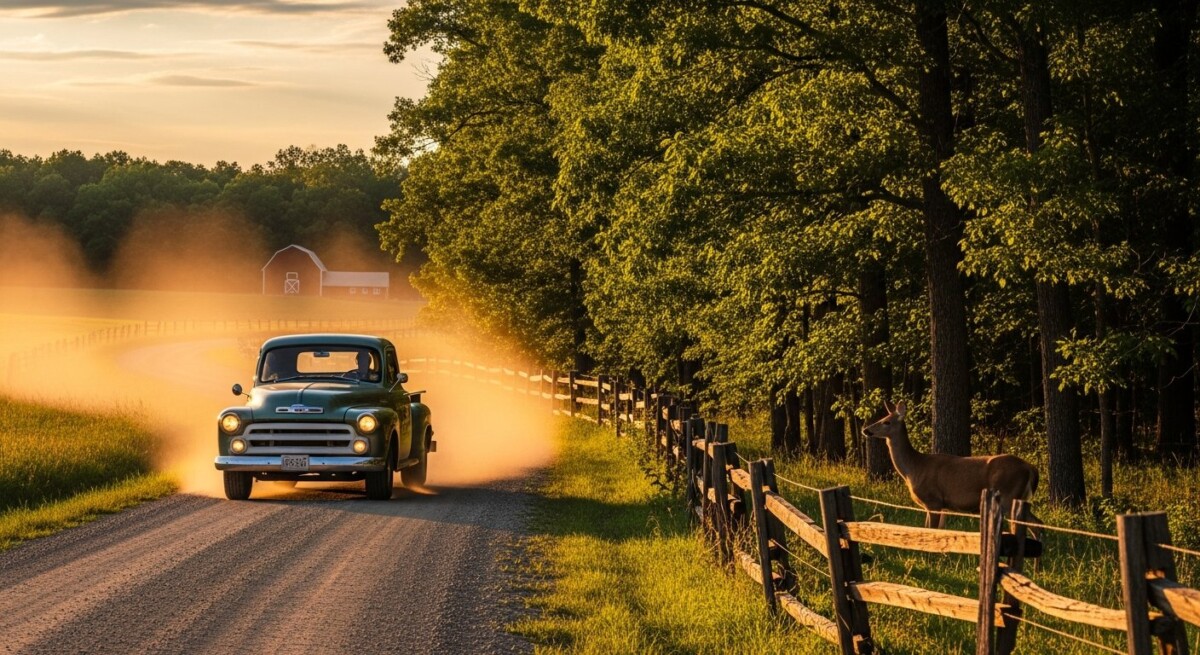
Comprehensive insurance covers damage not caused by a collision. This is your first line of defense against deer, elk, moose, and other large animals that frequently cross rural roads. The Insurance Institute for Highway Safety reports that animal strikes cause over 200 human deaths and 26,000 injuries each year in the United States. Most of these incidents occur on two-lane roads in rural areas at dawn and dusk. Comprehensive coverage also protects against hail damage, falling tree branches, and flooding, all of which are more common in open country.
Make sure your comprehensive deductible is set at a level you can afford. A $500 deductible is common, but if you live in an area with frequent deer crossings, consider a $200 or $250 deductible to avoid a large out-of-pocket expense after a strike. The premium difference between a $500 and $250 deductible is usually modest, often $5 to $15 per month.
Higher Liability Limits for Long-Distance Driving
Rural drivers tend to log more miles annually than urban drivers. Longer commutes to work, school, and grocery stores mean more time on the road. More miles equal more exposure to accidents. State minimum liability limits are rarely enough to cover the costs of a serious crash. If you cause an accident that injures multiple people, a $25,000 per person limit could leave you personally responsible for tens of thousands of dollars in medical bills.
Consider raising your liability limits to at least $100,000 per person and $300,000 per accident. This provides a stronger safety net without dramatically increasing your premium. In our guide on how to get AAA auto insurance quotes and compare rates, we explain how bundling higher liability limits with other coverages can actually lower your overall cost per mile.
Roadside Assistance and Towing
Breaking down on a remote highway is a different experience than stalling in a city. In a rural area, cell service may be spotty, the nearest tow truck could be 45 minutes away, and the cost of a long-distance tow can exceed $500. Roadside assistance coverage typically costs less than $5 per month and includes towing up to a certain distance, fuel delivery, flat tire changes, and lockout services. This is one of the most cost-effective add-ons for rural drivers.
Some insurers also offer trip interruption coverage, which reimburses you for lodging and meals if your vehicle breaks down far from home. This is valuable for rural drivers who frequently travel through sparsely populated states or regions.
Money-Saving Strategies for Country Drivers
Rural drivers have several opportunities to lower their premiums that urban drivers may not. The first is taking advantage of low-mileage discounts. If you work from home, farm on your property, or only drive a few thousand miles per year, you may qualify for a pay-per-mile insurance policy. These policies track your actual mileage through a telematics device or smartphone app and charge you a base rate plus a per-mile fee. For rural drivers who keep their vehicles parked most of the week, this can cut premiums by 30 to 40 percent.
Another strategy is to increase your deductible on collision and comprehensive coverage. Since rural areas have fewer accidents, the odds of filing a collision claim are lower. Raising your deductible from $500 to $1,000 can reduce your premium by 10 to 15 percent. Just ensure you have that amount saved in an emergency fund.
Bundling your auto policy with a home, farm, or renters insurance policy from the same carrier often unlocks a multi-policy discount. Many rural households own multiple vehicles, farm equipment, and outbuildings. Insuring everything under one roof simplifies billing and can save 10 to 25 percent on each policy.
Finally, ask about discounts for vehicles equipped with safety features like anti-lock brakes, electronic stability control, and daytime running lights. If you drive a pickup truck or SUV with high ground clearance and off-road tires, you may also qualify for a discount if the vehicle is used primarily for farming or ranch work rather than daily commuting.
Common Misconceptions About Rural Auto Insurance
One widespread myth is that rural auto insurance is always cheaper than urban insurance. As we have seen, this is not necessarily true. While liability rates are lower, comprehensive and collision rates can be higher due to animal strikes and road hazards. The total premium depends on your specific location, driving habits, and vehicle type. Always compare quotes from multiple carriers to find the best rate for your situation.
Another misconception is that you do not need uninsured motorist coverage because everyone in your small town knows each other. In reality, rural areas have higher rates of uninsured drivers. Many residents work seasonal jobs and let their insurance lapse between harvests. Uninsured motorist coverage protects you against these drivers and also covers hit-and-run accidents, which are more common on remote roads without witnesses.
A third myth is that you can skip comprehensive coverage if your vehicle is older. While it is true that the value of an older car may not justify a comprehensive premium in a city, the risk of animal strikes and hail damage does not decrease with the car’s age. A $3,000 repair bill for a deer strike could be financially devastating, even on a paid-off vehicle. Run the numbers before dropping comprehensive coverage.
How to Compare Rural Auto Insurance Quotes
The best way to find affordable auto insurance for vehicles in rural areas is to shop around. Start by gathering quotes from at least three different insurers that specialize in rural or agricultural policies. Large national carriers like State Farm and Nationwide have strong rural networks, but regional mutual insurance companies often offer better rates for farmers and ranchers because they understand the local risks.
When comparing quotes, pay attention to the coverage limits and deductibles rather than just the monthly premium. A cheap policy with low liability limits could leave you exposed. Look for policies that include comprehensive and collision coverage with deductibles you can manage, plus uninsured motorist protection. Also check the insurer’s financial strength rating from A.M. Best or Standard & Poor’s. You want a company that will be able to pay claims quickly after a major storm or wildfire.
Consider using a comparison platform like Free Auto Insurance Quotes Online to receive personalized quotes from multiple licensed agents in your state. This saves you the time of calling each insurer individually and ensures you are comparing apples to apples. For a deeper look at one major carrier, read our analysis of Geico auto insurance: a deep dive into coverage and value. While Geico is known for competitive rates, its rural discounts may differ from those offered by regional carriers.
State-Specific Considerations for Rural Drivers
Insurance regulations vary significantly by state, and rural drivers need to be aware of their state’s minimum requirements and unique laws. For example, Kentucky requires drivers to carry personal injury protection (PIP) coverage, which pays for medical expenses regardless of fault. This can be beneficial for rural drivers who live far from hospitals. Our guide on Kentucky auto insurance: a guide to coverage and savings explains how to balance PIP with other coverages to avoid overlap.
In Massachusetts, rural drivers face different challenges due to the state’s unique insurance rating system. The Commonwealth uses a tiered system that heavily weights your driving record and territory. Rural counties often receive favorable territory ratings, but the state also requires bodily injury liability limits of $20,000 per person and $40,000 per accident, which may be too low for serious crashes. Learn more in our article on a complete guide to auto insurance in Massachusetts for drivers.
If you live in a state with no-fault insurance laws, such as Florida or Michigan, your medical coverage is handled by your own insurance first. Rural drivers in these states should ensure their PIP limits are high enough to cover ambulance transport to a distant trauma center, which can cost thousands of dollars.
Frequently Asked Questions
Is auto insurance cheaper for rural drivers?
Not always. Liability rates tend to be lower due to less traffic, but comprehensive and collision rates can be higher because of animal strikes, road hazards, and longer distances to repair shops. The total premium depends on your specific location and coverage choices. Comparing quotes is the only way to know for sure.
Do I need comprehensive coverage if I live on a farm?
Yes, comprehensive coverage is strongly recommended for rural drivers. It protects against deer strikes, hail, falling branches, and vandalism. Even if your vehicle is older, the cost of repairing damage from an animal collision or hailstorm can exceed the vehicle’s value. Dropping comprehensive may save a few dollars monthly but could leave you with a large repair bill.
What is the best deductible for a rural driver?
A $500 deductible on comprehensive and collision coverage is a good balance for most rural drivers. If you live in an area with very frequent deer strikes, consider a $250 deductible to reduce out-of-pocket costs. If you have a healthy emergency fund and drive fewer than 7,000 miles per year, a $1,000 deductible can lower your premium significantly.
Can I get a discount for driving a farm vehicle?
Some insurers offer discounts for vehicles used primarily for agricultural purposes, such as farm trucks or tractors. You may also qualify for a low-mileage discount if the vehicle is only driven occasionally. Be honest with your insurer about how the vehicle is used. Misclassifying a farm vehicle as a personal vehicle could lead to claim denial.
How do I file a claim after hitting a deer?
First, ensure everyone in the vehicle is safe and move to the side of the road if possible. Call law enforcement to report the accident, as some states require a police report for insurance claims. Take photos of the damage and the surrounding area. Then contact your insurance company to file a comprehensive claim. Most insurers have 24/7 claims lines and mobile apps for quick submission.
Finding the right auto insurance for vehicles in rural areas requires understanding your unique risks and shopping for coverage that addresses them. Do not settle for a one-size-fits-all policy. Instead, evaluate your driving habits, the condition of your local roads, and the wildlife in your region. By tailoring your coverage and taking advantage of rural-specific discounts, you can protect yourself and your finances without overpaying. For personalized quotes from multiple carriers, call us at 833-275-7533 or use our online comparison tool to see how much you could save today.