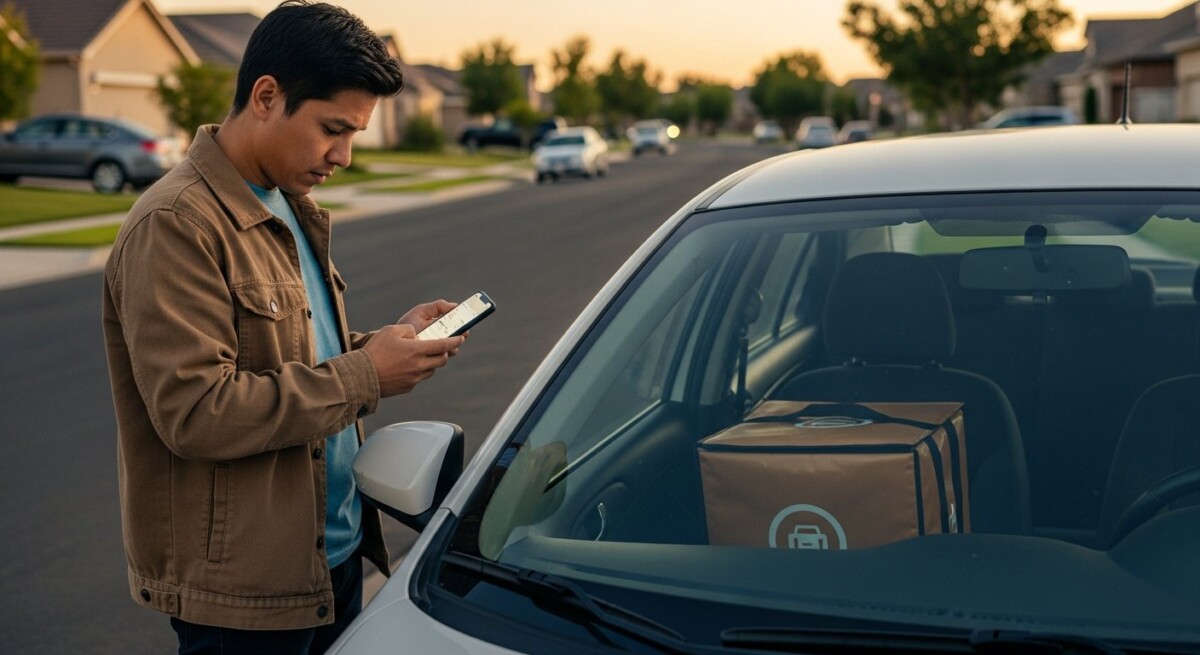
If you earn a living delivering food, packages, or groceries, you face a unique and often confusing insurance risk every time you start your car. Your personal auto insurance policy likely contains a “livery exclusion,” a clause that denies coverage if you are in an accident while using your vehicle for a delivery purpose. This means a single fender bender during a paid delivery could leave you personally responsible for thousands in damages, medical bills, and legal fees, potentially wiping out your income and savings. Navigating the gap between personal and commercial coverage is the single most critical financial decision for anyone in the gig economy. This guide will clarify your options, from ride-share endorsements to full commercial policies, ensuring you are legally compliant and financially protected on every trip.
The Critical Coverage Gap: Personal vs. Commercial Use
Understanding the fundamental difference between personal and commercial auto insurance is the first step to protecting yourself. A standard personal auto policy is designed for personal errands, commuting to a fixed workplace, and leisure driving. The moment you accept a delivery request through an app like DoorDash, Uber Eats, or Amazon Flex, you have entered a phase of vehicle use that insurers classify as “business” or “commercial” activity. This is not a gray area, it is a contractual red line. The livery exclusion, common in nearly all personal policies, is activated by this activity. If you cause an accident while the app is on and you are available for deliveries, or actively transporting an order, your personal insurer can, and often will, deny the claim entirely. This leaves you exposed to paying for the other driver’s vehicle repairs and medical expenses out of pocket, as well as your own.
You might think the delivery platform’s insurance will cover you. While companies like Uber and Lyft provide contingent liability coverage during certain periods, this coverage often has high deductibles and may only apply after your personal policy denies the claim, a process that can trigger significant complications. Furthermore, their coverage for damage to your own vehicle is typically minimal or non-existent unless you purchase additional protection through their app. Relying solely on the platform’s policy is a dangerous gamble. For comprehensive protection, you need a policy that explicitly covers your delivery work. As outlined in our guide on filing a California auto insurance claim, navigating claim denials is a complex and stressful process best avoided with proper upfront coverage.
Your Insurance Options as a Delivery Driver
Delivery drivers generally have three primary pathways to secure appropriate auto insurance. The right choice depends on the volume of your work, your vehicle, and your budget.
Rideshare or Delivery Endorsement (Hybrid Policy)
This is the most common and often most cost-effective solution for part-time and many full-time delivery drivers. It is an add-on, or endorsement, to your existing personal auto insurance policy. This endorsement is specifically designed to cover the “gap” periods that standard personal and platform policies miss: Period 1, when the app is on but you have not yet accepted an order, and Period 2, when you are actively en route to pick up or drop off a delivery. It provides seamless coverage that bridges your personal policy and the platform’s commercial policy that activates during an active trip. Major insurers like Progressive, GEICO, and State Farm offer these endorsements, but availability and terms vary by state.
Commercial Auto Insurance Policy
For drivers who use their vehicle primarily or exclusively for business, a formal commercial auto insurance policy is the appropriate and most robust solution. This is essential if you operate under your own business name, have multiple drivers, or carry specialized equipment. Commercial policies offer higher liability limits, coverage for hired and non-owned vehicles, and can include cargo insurance. They are more expensive than a hybrid endorsement but provide unambiguous, full-time business coverage without worrying about gaps or exclusions. This is the standard for traditional courier services and is increasingly necessary for high-volume gig workers.
Business Use Policy
Some insurers offer a “business use” classification on a personal policy, which is different from a full commercial policy. This may suffice for very low-level business mileage, but it is crucial to explicitly confirm with your agent that it covers food and parcel delivery activities. Many business use classifications are for salespeople or service technicians, not for delivery, and may still trigger the livery exclusion. Never assume, always get written confirmation.
Choosing the wrong policy can be a costly error. For a deeper understanding of how policy specifics can vary by location, consider reviewing auto insurance in Massachusetts for drivers, which highlights state-mandated coverage differences.
Key Coverages to Secure and Understand
Beyond the basic liability required by law, delivery drivers should strongly consider several additional coverages due to their increased risk and time on the road.
First, collision and comprehensive coverage are non-negotiable for protecting your own vehicle. If you rely on your car for income, repairing or replacing it quickly after an accident, theft, or vandalism is critical. Remember, the delivery platform’s insurance rarely covers your vehicle damage. Second, uninsured/underinsured motorist (UM/UIM) coverage is vital. You encounter many drivers daily, and if one without adequate insurance hits you, this coverage pays for your medical bills and vehicle damage. Third, consider medical payments or personal injury protection (PIP), which covers medical expenses for you and your passengers regardless of fault. Finally, if you are transporting high-value items, inquire about cargo insurance, which may be available as an add-on to some hybrid or commercial policies.
When evaluating policies, pay close attention to the stated limits. Minimum state liability limits are often woefully inadequate for a serious accident. As a business operator, you are a target for lawsuits. Increasing your liability limits to 100/300/100 (meaning $100,000 per person, $300,000 per accident for bodily injury, and $100,000 for property damage) is a wise investment. For many drivers, especially those considering their long-term financial safety, exploring options from providers that cater to specific demographics can be insightful. Our AARP auto insurance review details benefits that may be relevant for eligible delivery drivers.
Steps to Get Properly Insured
Taking a systematic approach will help you find the best coverage at a competitive rate. Follow these steps to ensure you are fully protected.
- Audit Your Current Policy: Read your personal auto insurance policy documents, specifically looking for the “livery exclusion” or “delivery exclusion” clause. Understand exactly what is not covered.
- Contact Your Current Insurer: Inquire if they offer a rideshare or delivery endorsement for your policy. Get a quote for adding this endorsement, including the cost to increase your liability limits.
- Shop Around with Specialized Providers: Not all insurers cater to the gig economy. Get quotes from companies known for hybrid policies (e.g., Progressive, Allstate) and those specializing in commercial insurance for small businesses.
- Disclose Everything Honestly: When applying, be completely transparent about your delivery work: which apps you use, how many hours per week you drive, and your estimated business mileage. Misrepresentation is grounds for claim denial.
- Compare Apples to Apples: Ensure each quote has identical coverage types, limits, and deductibles. The cheapest option may have critical coverage gaps.
- Formalize and Carry Proof: Once you select a policy, ensure you have proof of insurance in your vehicle at all times, both in physical and digital form. Notify your delivery platforms of your new insurance details if required.
Following this process not only secures your coverage but also builds a documented history of responsible business practice. For drivers at any stage of their career, understanding the full landscape of insurance options is key. Mature drivers can find additional context in our comprehensive AARP auto insurance review for drivers over 50, which discusses stability and customer service factors.
Frequently Asked Questions
Will my insurance company know I’m doing delivery if I don’t tell them? Yes, they likely will. In the event of a claim, insurers thoroughly investigate. They will subpoena your phone records, app data, and transaction history. Discovery of undisclosed delivery work will result in claim denial and likely policy cancellation.
Is a rideshare endorsement the same as delivery insurance? While often under the same product umbrella, you must confirm with the insurer. Some “rideshare” endorsements are written specifically for transporting passengers (TNC) and may not explicitly cover goods delivery. Always verify that your specific work is covered.
How much more expensive is proper insurance for delivery drivers? Costs vary widely. A rideshare/delivery endorsement typically adds 15-30% to your personal premium. A full commercial policy can be 50-100% more expensive or higher. Your driving record, location, vehicle, and mileage are major factors.
What if I only deliver part-time, a few hours a week? Even part-time activity invalidates the personal policy during those business hours. You are not “part-time exposed,” you are fully exposed during those periods. A hybrid endorsement is the minimum recommended coverage.
Do I need extra insurance if I use a bicycle or scooter for delivery? Possibly. Your personal health insurance and renters/homeowners policy may offer some liability protection, but you should specifically inquire about business use. Specialized commercial liability policies for cyclists are available.
Securing the right auto insurance for delivery drivers is not an optional expense, it is a fundamental cost of doing business. It protects your assets, your income stream, and your financial future. By understanding the risks, evaluating your options, and investing in a policy that explicitly covers your work, you drive with confidence, knowing that a single accident won’t derail your livelihood. The peace of mind that comes with proper coverage is the ultimate delivery, ensuring your safety and security on every route you take.